
Bridging the Gap to Essential Autism Care
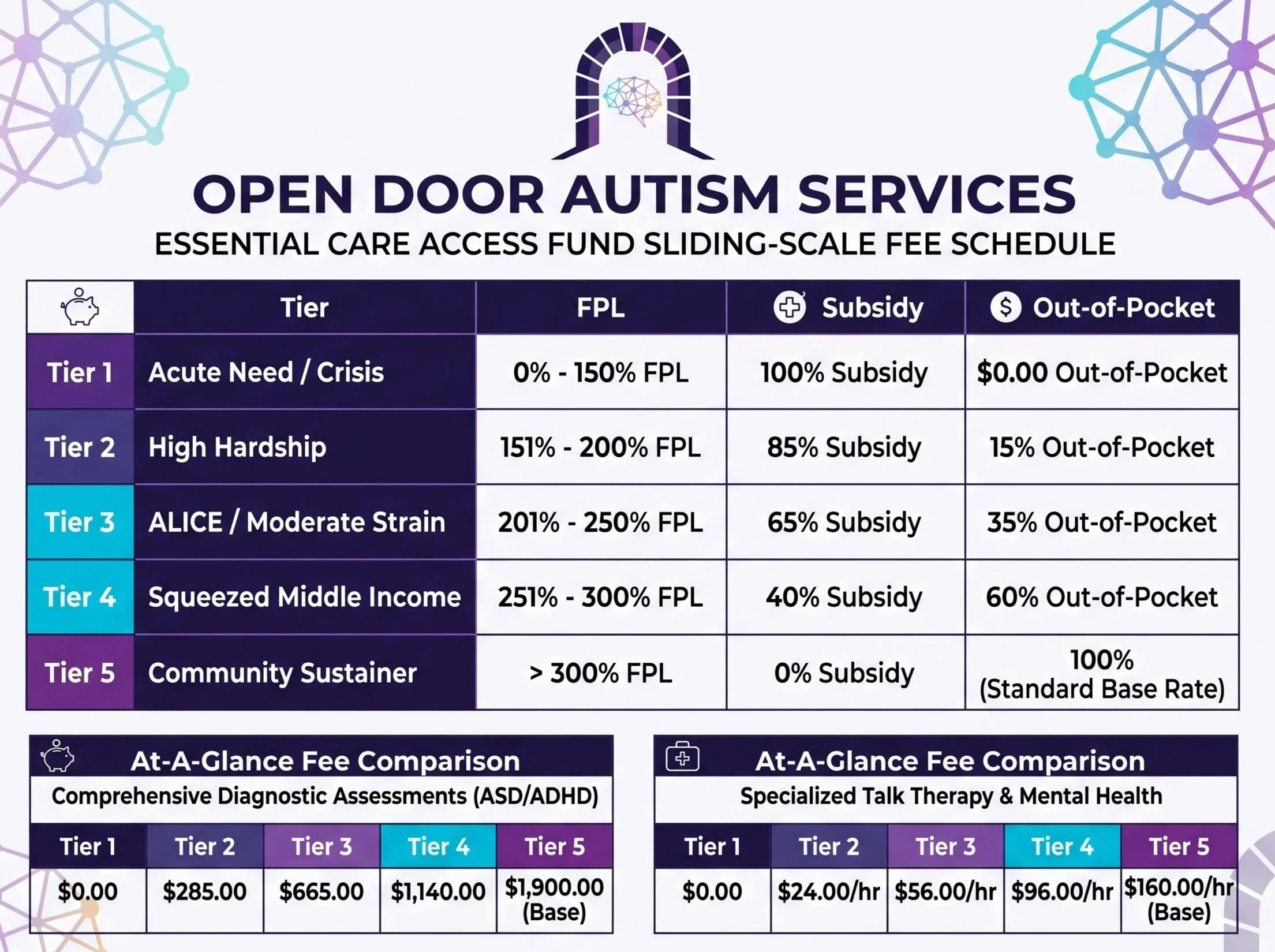
Gold-standard neurodevelopmental assessments and neurodiversity-affirming psychotherapy shouldn’t depend on your wealth. Through our donor-backed Care Fund, we offer an equitable 5-tier sliding scale ensuring care is accessible to every family.
Who Qualifies?
The Essential Care Access Fund is a sliding-scale subsidy framework that ensures virtually everyone can access care—whether they require completely free services or simply need a moderate discount to afford care[cite: 1]. Eligibility is calculated based on verified household income relative to the Federal Poverty Guidelines
-
Who it’s for: Families experiencing acute financial hardship, underemployment, or crisis.
Care Fund Subsidy: 100% covered (Fully subsidized).
Patient Cost: $0.00 for all clinical assessments and talk therapy.
Annual Income Examples (2026 FPL):
Household of 1: Under $23,940
Household of 2: Under $32,460
Household of 3: Under $40,980
Household of 4: Under $49,500
Household of 6: Under $66,540
-
Who it’s for: Families with highly limited resources who are struggling to make ends meet.
Care Fund Subsidy: 85% covered.
Patient Cost: Only 15% of the base rate[cite: 1] (e.g., $285 for a full diagnostic evaluation, or $24/hr for therapy).
Annual Income Examples (2026 FPL):
Household of 1: $23,941 to $31,920
Household of 2: $32,461 to $43,280
Household of 3: $40,981 to $54,640
Household of 4: $49,501 to $66,000
Household of 6: $66,541 to $88,720
-
Who it’s for: The ALICE population (Asset Limited, Income Constrained, Employed)—working families who earn above the poverty line but have high expenses and no wiggle room for clinical costs.
Care Fund Subsidy: 65% covered.
Patient Cost: 35% of the base rate[cite: 1] (e.g., $665 for a full diagnostic evaluation, or $56/hr for therapy).
Annual Income Examples (2026 FPL):
Household of 1: $31,921 to $39,900
Household of 2: $43,281 to $54,100
Household of 3: $54,641 to $68,300
Household of 4: $66,001 to $82,500
Household of 6: $88,721 to $110,900
-
Who it’s for: Families who are "squeezed" by high cost of living but earn too much to qualify for public assistance, yet are underinsured or find specialized autism care out of reach.
Care Fund Subsidy: 40% covered.
Patient Cost: 60% of the base rate[cite: 1] (e.g., $1,140 for a full diagnostic evaluation, or $96/hr for therapy).
Annual Income Examples (2026 FPL):
Household of 1: $39,901 to $47,880
Household of 2: $54,101 to $64,920
Household of 3: $68,301 to $81,960
Household of 4: $82,501 to $99,000
Household of 6: $110,901 to $133,080
-
Who it’s for: Families whose household income comfortably exceeds 300% of the poverty level, or who have robust insurance that fully covers out-of-pocket care.
Care Fund Subsidy: 0% Subsidy (Clients pay our highly competitive, standard base rate).
Patient Cost: 100% of base rate[cite: 1] (e.g., $1,900 for a full diagnostic evaluation, or $160/hr for therapy).
Annual Income Examples (2026 FPL):
Household of 1: Above $47,880
Household of 2: Above $64,920
Household of 3: Above $81,960
Household of 4: Above $99,000
Household of 6: Above $133,080
How Insurance Works at Open Door Autism Services
At Open Door, our sliding-scale framework and the Essential Care Access Fund are designed to be as straightforward and worry-free as possible. Because we focus our resources on direct care, we do not utilize "Superbills" or expect families to chase out-of-network reimbursements on their own. Instead, we ensure your assigned tier remains your primary financial protection.
Here is exactly how insurance is handled:
1. The Essential Care Hardship Protection
For eligible families, your income-verified sliding-scale tier establishes your maximum out-of-pocket responsibility. When courtesy insurance claims are processed, third-party payer determinations will not increase your financial contribution beyond your assigned tier.
How It Works: If an eligible family is approved for Tier 2 ($24/hr therapy session), but their commercial insurance applies a higher copayment, coinsurance, or deductible, the family's out-of-pocket responsibility remains $24. The remaining patient-responsibility balance is formally covered as a charitable financial assistance grant through the Open Door Essential Care Access Fund based on your documented financial eligibility.
Eligibility Note: Sliding-scale placement and hardship grant protections are awarded solely on the basis of verified household size and gross annual income relative to Federal Poverty Guidelines. They are applied uniformly across all practice service lines and do not constitute routine or arbitrary fee waivers.
2. Direct Courtesy Claims Filing
To minimize the administrative and paperwork burden on your family, Open Door does not issue Superbills for patient self-submission.
Seamless Administrative Support: Where eligible commercial out-of-network benefits exist, Open Door facilitates claims coordination directly through an Assignment of Benefits (AOB) courtesy filing.
Hassle-Free Care: Our administrative team handles the submission of clinical documentation and standard diagnostic coding directly to your payer on your behalf, eliminating the need for you to navigate complex claim portals or file manual reimbursement paperwork.
3. The Charitable Reinvestment Cycle
Open Door Autism Services operates as a 501(c)(3) nonprofit healthcare provider dedicated to closing systemic access gaps in neurodevelopmental care. When an out-of-network insurance claim yields a direct reimbursement to Open Door:
Replenishing the Fund: Recovered insurance proceeds directly offset the internal grant initially drawn from the Open Door Essential Care Access Fund for that service.
Expanding Community Impact: Every dollar recovered is immediately recirculated to sponsor diagnostic evaluations and psychotherapy sessions for the next waitlisted child or family needing hardship assistance.
By allowing Open Door to file courtesy claims on your behalf, your insurance coverage actively sustains our nonprofit mission—helping another neurodivergent individual access gold-standard care while keeping your out-of-pocket costs strictly protected at your verified tier level.
Financial Assistance Disclaimer: Open Door Autism Services is a 501(c)(3) nonprofit[cite: 1]. Our Sliding-Scale Fee Schedule is made possible entirely through charitable donor contributions to the Open Door Essential Care Access Fund[cite: 1]. Eligibility for Tiers 1 through 4 is determined on a case-by-case basis through verification of gross household income and household size relative to Federal Poverty Guidelines[cite: 1]. Our sliding-scale discounts and insurance capping policies are designed to alleviate verified financial hardship and are applied uniformly based on documented need[cite: 1]. They are not blanket waivings of co-payments or deductibles[cite: 1.4.4].